
Published in Schizophrenia Bulletin, a new study led by Dr. Yi Wang from the Institute of Psychology, Chinese Academy of Sciences (CAS) has identified a key neural mechanism linking negative schizotypy to empathic deficits. The findings reveal that reduced neural synchronization in specific brain circuits impairs individuals’ affective empathy, shedding new light on social cognitive dysfunctions in schizophrenia spectrum disorders.
Social cognitive impairment is a core hallmark of schizophrenia spectrum disorders, with empathic deficits severely undermining social adaptation. Empathy includes cognitive and affective subcomponents, yet the neural basis of empathy dysfunction in psychosis vulnerability remains unclear. As a subclinical personality trait conferring psychosis risk, schizotypy is divided into negative, positive, and disorganized dimensions. Negative schizotypy, marked by social anhedonia and blunted affect, is closely associated with empathic impairments. Studying healthy individuals with schizotypy avoids clinical confounding factors, helping identify early neural deficits before illness onset. This study focused on how schizotypal traits shape neural synchronization during empathic processing, a previously underexplored question.
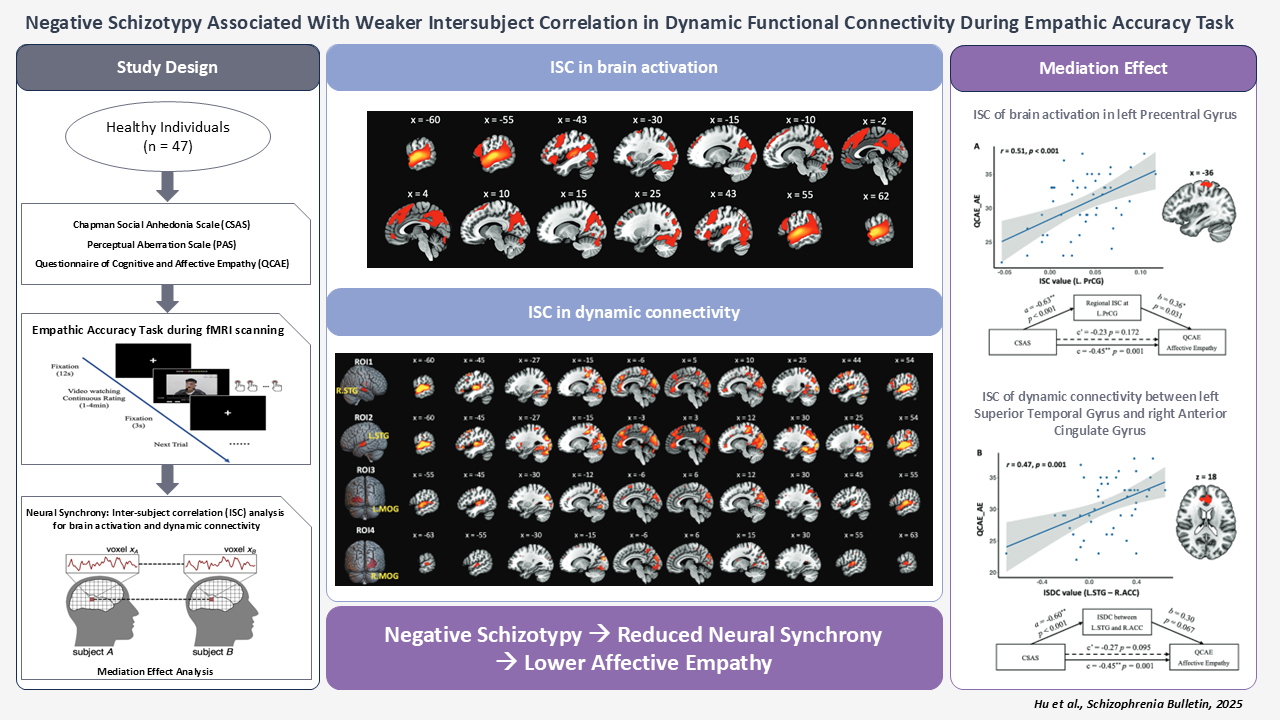
This research recruited 47 healthy college students with no neurological or psychiatric disorders. All participants completed schizotypal trait and empathy assessments and underwent 3T functional magnetic resonance imaging (fMRI) scanning. Researchers used the Chapman Social Anhedonia Scale (CSAS) and Perceptual Aberration Scale (PAS) to measure negative and positive schizotypy, and the Questionnaire of Cognitive and Affective Empathy (QCAE) to evaluate cognitive and affective empathy. Participants finished the Chinese version of the Empathic Accuracy Task (EAT) during fMRI scanning. The team adopted General Linear Model (GLM), intersubject correlation (ISC), intersubject dynamic connectivity (ISDC), and mediation analyses to unpack relevant neural mechanisms.
The results confirmed that empathic accuracy relies on a canonical social cognitive network, including the occipital gyrus, precuneus, lingual gyrus, paracentral gyrus, and anterior cingulate cortex (ACC). The bilateral superior temporal gyrus (STG) showed robust intersubject neural synchronization across all participants during empathy processing. Dimension-specific analyses showed that only negative schizotypy was negatively associated with affective empathy, while positive schizotypy exerted no significant influence on empathy. Higher negative schizotypy corresponded to weaker neural synchronization in the left precentral gyrus and reduced dynamic connectivity synchronization between the left STG and right ACC/dorsomedial prefrontal cortex. Mediation analyses validated a reliable causal pathway: attenuated synchronization in the left precentral gyrus and disrupted STG–ACC dynamic connectivity fully mediated the negative association between negative schizotypy and affective empathy, explaining 50% and 40% of the behavioral variance respectively. Notably, schizotypy traits did not alter task-evoked brain activation magnitude, indicating that subclinical empathic deficits originate from impaired neural synchrony rather than regional activation abnormalities.
Theoretically, this study clarifies the specific linkage between negative schizotypy and affective empathy impairment, establishing disrupted neural synchronization as a core neural signature of subclinical social cognitive deficits. It substantially advances the neurodevelopmental understanding of schizophrenia spectrum psychopathology. Clinically, the identified neural synchronization biomarkers provide objective indicators for early identification of psychosis-vulnerable populations. The STG–ACC and precentral gyrus circuit abnormalities also offer novel neuromodulation targets to treat social cognitive impairments, supporting early prevention and precise intervention for schizophrenia spectrum disorders. Future research will incorporate disorganized schizotypy and adopt controlled group comparisons to further refine the neural mechanisms of social cognitive deficits and optimize early warning and intervention strategies for high-risk populations.
Paper Information:
Hu, D.-D, Guo, X., Lui, S. S. Y., Wang, Y., & Chan, R. C. K. (2025). Negative Schizotypy Associated With Weaker Intersubject Correlation in Dynamic Functional Connectivity During Empathic Accuracy Task. Schizophrenia Bulletin, 51(Supplement_2), S183–S193. https://doi.org/10.1093/schbul/sbad182